Research Focus
Paleoenvironmental Reconstruction
I integrate multidisciplinary techniques with the ultimate pursuit of reconstructing the paleodepositional conditions of sedimentary environments.
I focus on studying the modern and fossilized record of organisms as sediment modifiers, from micro- to macro-scale, to understand the nuanced physical and chemical conditions affecting a variety of depositional settings. My research combines modern and ancient animal behaviour with sedimentological, geochemical, paleontological, and ecological techniques to build high-resolution, complete records of environmental change through time.

Nereid bioirrigating in fine-grained sand
What is ichnology?
Ichnology is the branch of sedimentary geology and paleontology that deals with the study of trace fossils. Unlike body fossils, which preserve anatomical remains, trace fossils preserve records of animal behaviour through their interaction with, and manipulation of, sediments and substrates.
Tracks, trails, burrows, and borings all have the potential to be preserved in the sedimentary record. Recognizing and describing these features, and the ways they change through time, facilitates the reconstruction of: 1) ancient organism behaviour, 2) broad ecological diversity estimates, 3) evolution, extinction, and recovery dynamics, and 4) refined interpretations of both the physical and chemical conditions acting on sediments at the time of deposition.
Research Areas

Willapa Bay, WA USA (2023)
Neoichnology

Sampling the Aransas Bay estuary, TX USA (2026)
Like the rest of geologists, ichnologists live by the simple philosophy:
"The present is the key to the past"
To understand the infaunal imprint preserved in the rock record, we first must understand how modern animals interact with their substrates. Neoichnology bridges sedimentological, ichnological, and ecological approaches to characterize how organisms colonize diverse depositional settings and respond to environmental stress. Calibrating these modern interactions provides the baseline needed to decode ancient environmental shifts through changes in trace fossil communities.
SEDIMENTOLOGY
Process Ichnology and Paleoclimate
Rather than simply cataloging trace fossils, process ichnology treats them as biogenic sedimentary structures that, in conjunction with primary physical structures, record depositional dynamics. This framework links trace fossil morphology, cross-cutting relationships, and spatial distributions directly to the physicochemical conditions at and immediately below the sediment–water interface.
Ocean deoxygenation, a critical consequence of past and future global warming, predictably affects the infaunal benthic community. The biological response (marked by declines in population, community diversity, animal size, and depth to which animals burrow in seafloor sediment) is recorded in the sedimentological record as declines in burrow diversity, diameter, and depth of penetration. These records are currently used to understand relative changes in oxygenation. I am interested in advancing paleo-oxygenation models by leveraging these effects to understand a more quantitative record of oxygenation during periods of global change.
SEDIMENTARY GEOLOGY
SEDIMENTOLOGY
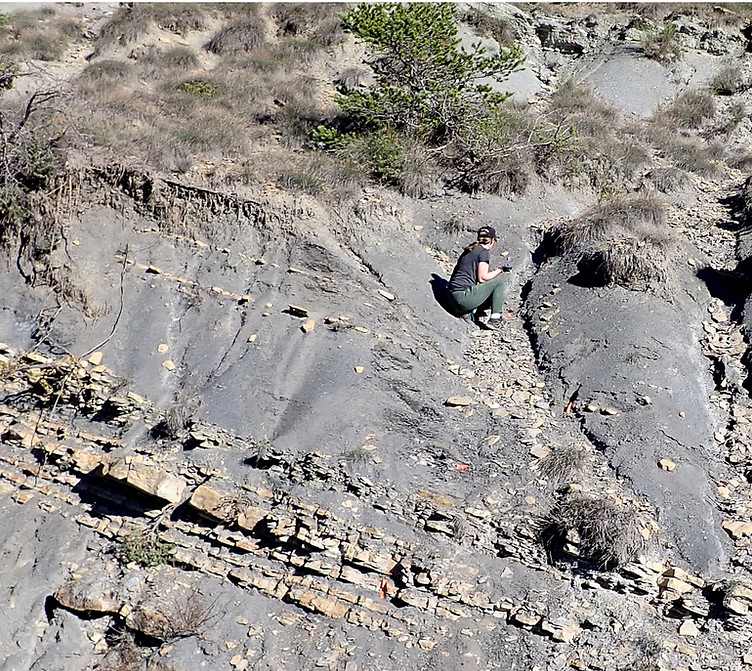
Late Cretaceous 'Oceanic Anoxic Event 2' interval, Vocontian Basin, France (2022)
Fine-grained Depositional Systems

Devonian Canol Fm., NWT Canada (2018)
Mudstones are enigmatic, compositionally diverse, and depositionally complex. While they are often dismissed as simple deposits settled in quiet, low-energy waters, modern sedimentology shows this is rarely the case.
Part of my research focuses on unravelling the nuanced physical and chemical conditions under which globally and temporally diverse fine-grained successions accumulate. This work is driven by two priorities: 1) the overwhelming prevalence of mudstones throughout the geologic record, particularly across intervals of major global change; and 2) the critical need to decode the mechanisms governing organic and mineral enrichment in deposits that remain both scientifically and economically vital.
SEDIMENTOLOGIKA
SEDIMENTARY GEOLOGY
The Small Animal Record
Sub-millimetre infaunal animals (meiofauna and exceptionally small macrofauna) dominate marine settings by population and biomass. Their small body size restricts their preserved biogenic imprint to fine-grained deposits (mudstones), which themselves dominate the sedimentary record. This makes these animals the largest, but least understood, contributors to the trace fossil record. Furthermore, these highly adaptable animals are remarkably resistant to environmental change, making them the first to colonize and the last to abandon marine sediments during times of crisis.
I am interested in decoding this subtle microscopic ichnological record within modern marine muds, and ancient mudstones, to refine high-resolution paleoenvironmental interpretations during past biotic crises.
EARTH SCIENCE REVIEWS

Microscopic biogenic reworking in a thin section from the Second White Specks Fm. (AB Canada)
Heading 5
Canol Fm., NWT Canada
